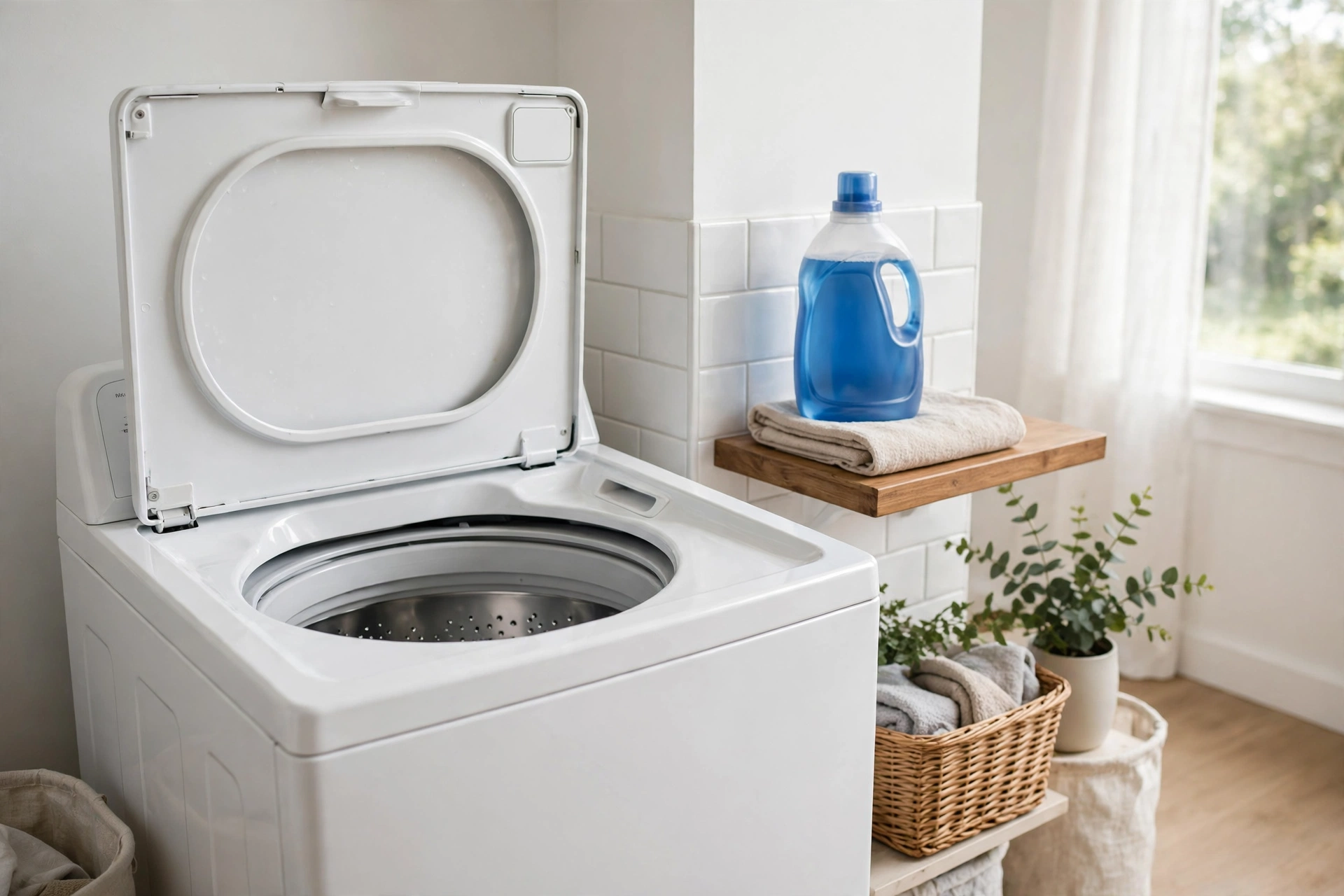
Top-load washer repair covers agitator faults, lid-switch faults, banging and grinding noises, off-balance shaking, and drain issues. A local provider diagnoses the machine at your home and repairs the faulty part.
Top-load washers are the machines most North Carolina homes grew up with: load from the top, agitator in the middle, lid on top. They are simple, sturdy machines, and their faults are usually simple too — a switch, a belt, a coupling, or the agitator itself.
The lid switch is the part top-load owners meet most often. The machine will not spin unless the lid is closed, and the switch is what tells the machine the lid is closed. When it fails, the machine fills and drains but never spins. Behind it sit the agitator, the drive belt, the motor coupling, and the suspension.
Agitator faults
The agitator is the finned post in the middle of the drum. It turns one way and then the other, moving the clothes through the water. When it stops turning, the clothes sit still and come out dirty.
An agitator that will not turn usually has worn agitator dogs — the small plastic cogs inside the agitator that let it ratchet in one direction. When they wear, the agitator spins freely both ways and does no work. Replacing the dogs is a small, common repair.
If the agitator does not move at all, the fault is usually deeper: the drive belt, the motor coupling, or the transmission. The provider tests the agitator by hand first, because a loose agitator with worn dogs feels different from an agitator that is locked solid.
An agitator that makes a grinding noise is usually telling the same story: the dogs are worn, or something is caught under the agitator. Either way, the agitator comes off and the fault is found before any part is ordered.
Lid-switch faults
The lid switch is a small safety switch under the lid. When the lid closes, the switch engages and the machine is allowed to spin. When the switch fails, the machine will not spin — even though it fills, washes, and drains normally.
A lid-switch fault shows up as a machine that stops before the spin, or a machine that will not spin at all. The switch is tested with a meter, and if it has failed it is replaced. It is one of the cheapest and most common top-load repairs.
Some owners work around a failed lid switch by holding it down or bypassing it. That is not safe — the switch exists because a spinning drum with an open lid can injure a hand. A failed switch should be replaced, not bypassed.
Banging and grinding noises
A top-load washer that bangs on spin is usually unbalanced, or the load is bunched on one side of the drum. Redistributing the load and running the spin again often clears it. If the machine still bangs with a balanced load, the suspension rods are the likely cause.
A grinding noise on spin usually means a worn drive component — the motor coupling, the clutch, or the transmission. A grinding noise during agitation usually means the agitator dogs or the transmission. The provider listens to when the noise happens, because the timing points to the part.
A clicking noise when the machine should start is usually the lid switch. A humming noise with no drum movement is usually a jammed pump or a seized motor. Each sound has a meaning, and the provider reads it before opening the machine.
Off-balance shaking
A top-load washer that shakes across the floor is usually not level, or the load is uneven, or the suspension rods have worn. Levelling feet are adjusted first, then the load is redistributed. If the machine still shakes with a balanced load on a level floor, the suspension is the cause.
Suspension rods carry the drum and let it move a little as it spins. When they wear, the drum moves too much, and the machine shakes and bangs. Replacing the rods is a proper repair, and it makes the machine run quietly again.
Heavy single items cause the worst shaking: a blanket, a rug, a load of towels bunched on one side. Washing heavy items with a few lighter ones around them balances the load and stops the shaking.
Drain issues on top-load machines
A top-load washer that will not drain usually has a blocked pump filter, a kinked drain hose, or a failed drain pump. The pump filter catches coins, hair, and lint before they reach the pump, and when it clogs the water has nowhere to go.
If the filter and hose are clear and the machine still will not drain, the pump is tested. A pump that hums but does not move water, or stays silent when it should run, has usually failed and needs replacing.
Before the visit, check that the drain hose is not kinked behind the machine. Do not tip the machine to empty it — a full drum is heavy and the water will go everywhere.
What affects the cost of a top-load repair
The part is the main factor. A lid switch and agitator dogs are small jobs; a drive belt and motor coupling are medium jobs; a transmission is a large one. The age of the machine matters too — a transmission on a fifteen-year-old machine is a different decision from a lid switch on a five-year-old one.
Parts for top-load machines are usually easy to find, because the design has changed little over the years and the same parts fit many models. The provider will say if a part needs ordering, and the visit is explained before the work starts.