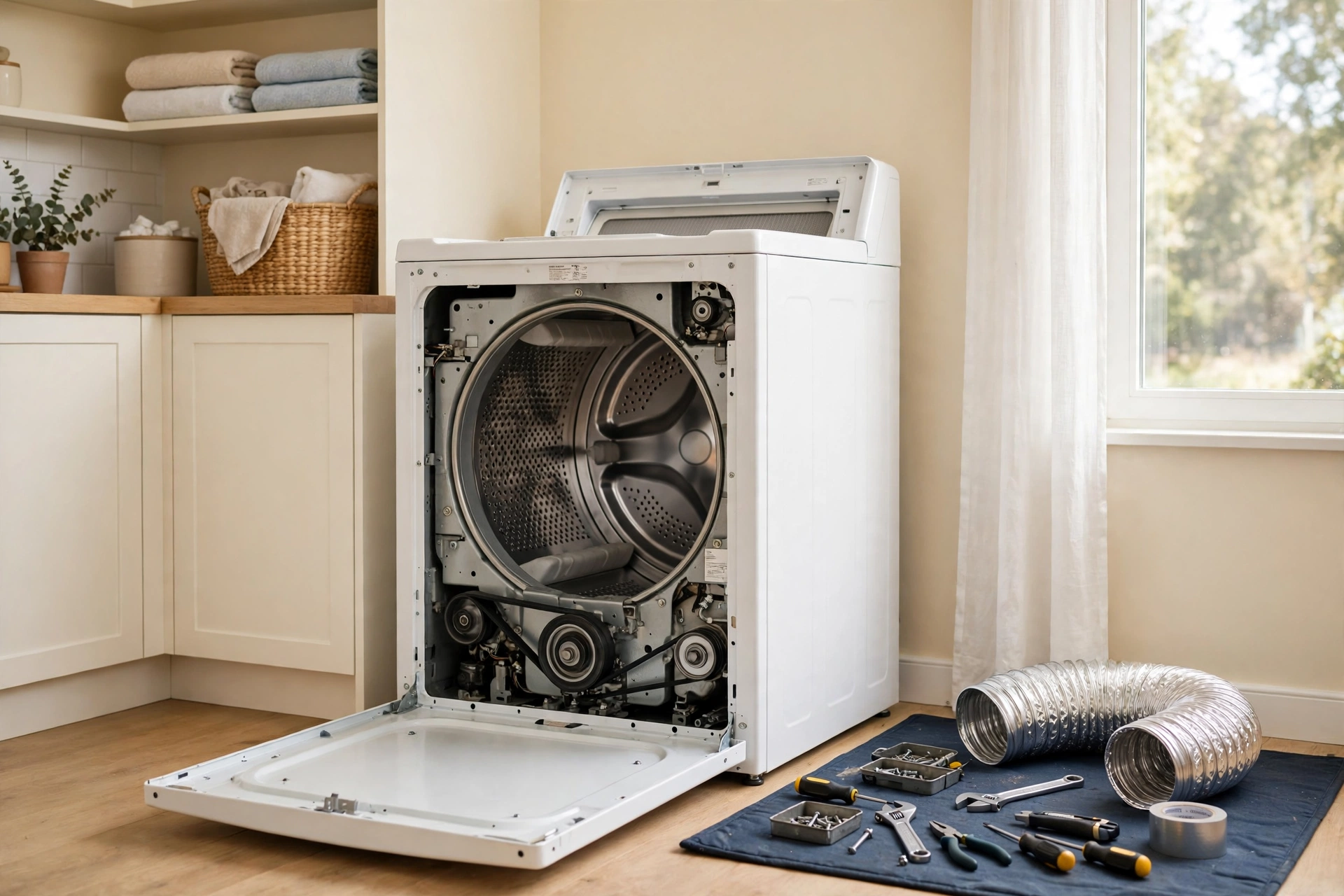
Dryer repair covers dryers that will not heat, will not spin, make a burning smell, or take too long to dry. A local provider diagnoses the dryer at your home and repairs the faulty part — heating element, belt, thermostat, thermal fuse, or vent.
A dryer has one job: hot air moving through tumbling clothes. When it stops doing that, the fault is usually in the heating, the drum drive, or the airflow. A dryer that runs but does not heat has a heating fault. A dryer that does not spin has a drive fault. A dryer that takes two cycles to dry has an airflow fault — usually the vent.
Dryer repair starts the same way washer repair does: describe what the dryer is doing, and the provider checks the parts in order. The heating element and thermostat, the belt and motor, the thermal fuse, and the vent are the parts that fail most often, and each one has its own signs.
Dryer not heating
A dryer that runs but does not heat is the most common dryer fault. The drum turns, the cycle runs, and the clothes come out damp. The cause is usually the heating element, the thermal fuse, or the thermostat.
The heating element is the part that makes the heat. When it fails, the dryer runs cold. The thermal fuse is a safety device that cuts the heat if the dryer gets too hot — and once it blows, the dryer will not heat again until the fuse is replaced. The thermostat controls the temperature; when it fails, the dryer either does not heat or overheats.
On a gas dryer, the same fault has different parts: the igniter lights the gas, and the gas valve controls the flow. A gas dryer that will not heat usually has a failed igniter or a faulty gas valve. The provider tests the heating parts in order, because replacing the wrong one does not fix the fault.
A blocked vent can also stop a dryer heating properly. When the hot air cannot escape, the dryer overheats, the thermal fuse blows, and the heat stops. That is why the vent is checked in every not-heating visit.
Electric dryer repair
Electric dryers heat with an element and run on a high-power circuit, and their faults are usually electrical: the heating element, the thermostat, the thermal fuse, or the timer. The provider tests each one with a meter before replacing anything.
A common electric dryer fault is the dryer that works on one heat setting and not another, which usually means a thermostat or a timer fault. A dryer that heats but never stops usually has a timer fault. A dryer that trips the breaker usually has a short in the element or the motor.
Electric dryers draw more power than almost any other appliance in the house, so the outlet and breaker are checked as part of the visit. A damaged outlet or a loose connection is a safety problem, and the provider will say so plainly rather than work around it.
Gas dryer repair
Gas dryers heat with a burner, and their faults are the igniter, the gas valve, and the flame sensor. The igniter glows to light the gas; when it fails, the dryer runs cold. The gas valve controls the gas flow; when it fails, the burner does not light. The flame sensor watches the flame; when it fails, the burner shuts off.
A gas dryer that heats for a few minutes and then goes cold usually has a failing gas valve coil — it works while cold and fails as it warms up. A gas dryer that never heats usually has a failed igniter.
Gas connections are checked for leaks as part of every gas dryer visit. If a gas smell is present, the gas supply should be closed and the room ventilated before the visit.
Drum not spinning and belt replacement
A dryer drum that will not spin usually has a broken belt. The belt connects the motor to the drum, and when it snaps the motor runs and the drum stays still. A belt that has stretched slips instead of gripping, and the drum turns slowly or not at all.
Belt replacement is a common dryer repair. The dryer is opened, the old belt is removed, the new belt is fitted around the drum and the motor pulley, and the drum is turned by hand to check the fit. The idler pulley and drum rollers are checked at the same time, because a worn roller makes the same noise as a worn belt.
A drum that will not spin can also be a failed motor or a broken door switch. The motor is tested, and the door switch is checked, because a dryer will not run with the door open — and a failed switch tells the dryer the door is open when it is not.
Burning smell and dryer vent cleaning
A burning smell from a dryer is usually lint. Lint builds up in the vent and around the heating element, and when it gets hot enough it smells of burning. The smell is a warning, not just a nuisance: a blocked vent is the most common cause of dryer fires.
Dryer vent cleaning clears the vent from the dryer to the outside, including the flexible hose behind the machine and the vent cap outside. A vent that is crushed behind the dryer, or that runs too far with too many bends, restricts airflow even when it is clean, and the provider will say so.
A dryer that takes too long to dry is usually a vent problem too. When the hot, moist air cannot escape, the clothes stay damp and the dryer runs longer. Cleaning the vent often fixes a dryer that seemed to be failing.
What affects the cost of a dryer repair
The part is the main factor. A thermal fuse and a belt are small jobs; a heating element and a motor are larger ones. Electric and gas dryers have different parts, and the provider will say which ones are needed before the work starts.
Vent cleaning is often part of the visit, and it is worth doing even when the fault is elsewhere — a clean vent makes the dryer work better, dry faster, and last longer. The provider explains the cost before the work starts, including the part and what the repair involves.