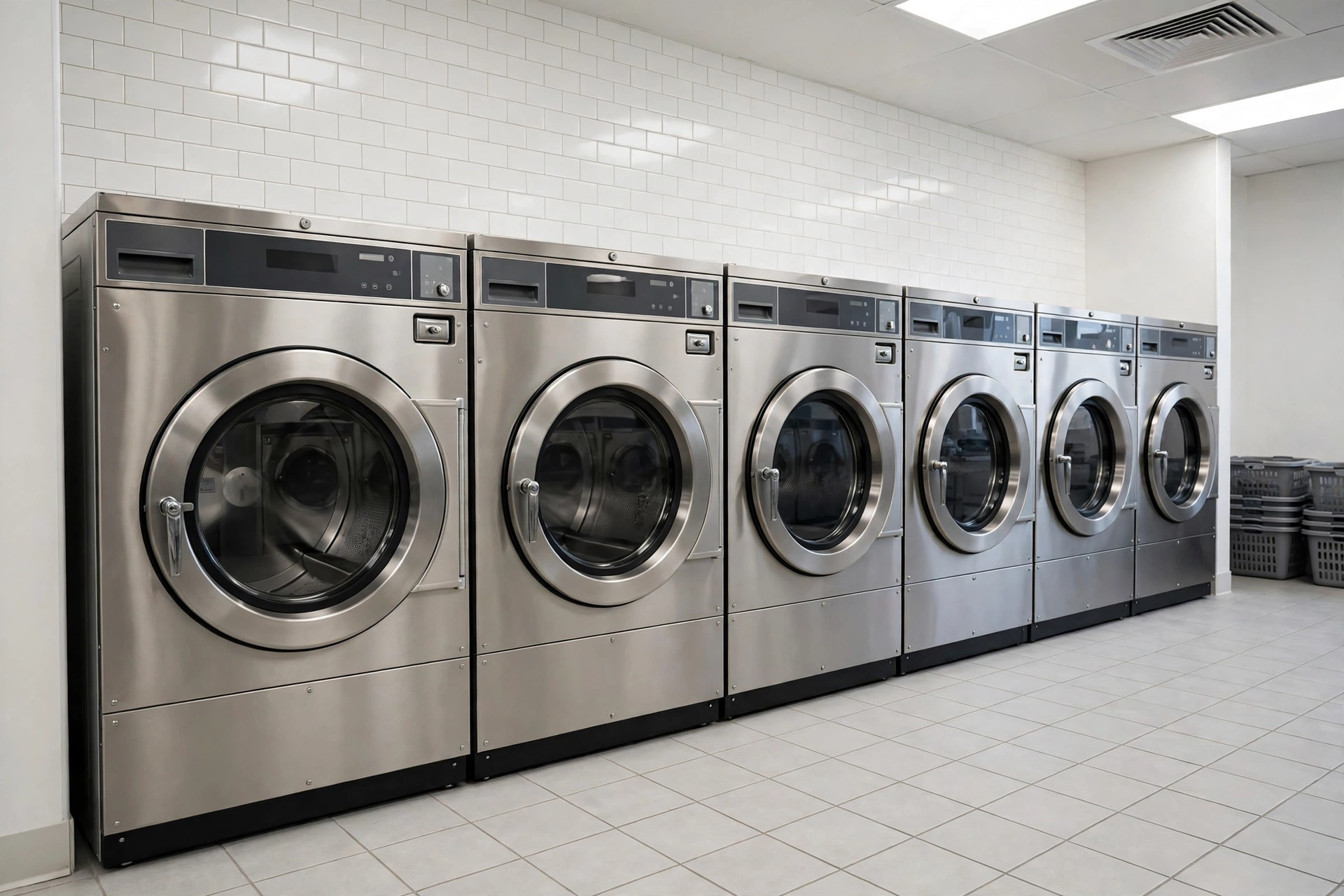
Commercial washer repair covers laundromats, apartment laundry rooms, hotels, and care homes. A local provider diagnoses the machine on site and repairs the faulty part, with downtime kept as short as the fault allows.
A commercial washer is a different machine from a home washer. It runs many cycles a day, it takes heavier loads, and it is used by people who did not buy it and do not maintain it. The faults are the same parts — pumps, belts, switches, valves — but they fail faster and the cost of downtime is higher.
For a laundromat, a dead machine is a dead income stream. For an apartment building, it is a queue of residents with laundry bags. For a hotel or care home, it is linen that cannot wait. Commercial repair is therefore about speed as much as skill: find the fault, fix it, and get the machine back in service.
Laundromats
A laundromat lives or dies by its machines. A washer that is out of service loses money every hour, and a row of machines with one dead unit pushes customers to the next laundromat down the road. Providers who work on laundromats know that the visit has to end with the machine running.
The faults are the usual ones, accelerated: drain pumps clogged with coins and debris, door latches worn from constant use, belts and couplings worn from heavy loads, inlet valves scaled by hard water. The provider checks the machine, the fault, and the other machines in the row — because a fault that has hit one machine will hit the next one soon.
Coin mechanisms and card readers are part of the job too. A machine that washes fine but will not start on payment is still out of service, and the provider checks the payment side as well as the wash side.
Apartment laundry rooms
An apartment laundry room serves every resident in the building, and a dead machine means a queue. The machines are usually shared, heavy-use units, and they fail the same way laundromat machines fail — pumps, belts, switches, and valves, worn by constant use.
Providers work around the residents: the machine is fixed on site, the room is left clean, and the other machines are checked while the provider is there. A fault that is starting on one machine is caught before it stops the next one.
For property managers, the visit is also a record: what failed, what was fixed, and what is likely to need attention next. That record helps plan maintenance instead of reacting to breakdowns.
Hotels and care homes
A hotel laundry room runs on a schedule, not on convenience. Linen has to be washed, dried, and back in the rooms, and a dead washer breaks the schedule. A care home laundry room is the same, with the added weight of hygiene: linen must be washed properly, at the right temperature, every time.
Providers who work on hotel and care home machines check the wash as well as the machine — the water temperature, the detergent feed, the drain — because a machine that runs but does not wash properly is still a problem.
Downtime is planned around the laundry schedule where possible, and the machine is tested through a full cycle before the provider leaves, so the next load is a real load, not a test.
Common commercial faults
The most common commercial faults are drain pump failures, door latch failures, drive belt and motor coupling wear, and inlet valve scaling. Hard water is a factor in many of them: scale builds up in valves and hoses, and the machines work harder to fill and drain.
Overloading is the other factor. Commercial machines take heavy loads, and when they are overloaded the suspension wears, the bearings wear, and the motor works harder than it should. Loading the machine to its rated capacity — not beyond it — is the simplest way to extend its life.
Preventive checks catch most of these faults early: the pump filter, the door seal, the hoses, and the belt. A provider who visits regularly sees the wear before it becomes a breakdown.
Downtime and planning
Downtime is the real cost of a commercial washer fault, and it is the first thing a provider thinks about. The visit is planned to end with the machine running, and if a part needs ordering, the provider says so plainly and gives a realistic time.
Where a building has several machines, the provider checks the others while on site. A pump that is starting to fail on one machine is a warning about the next, and catching it early saves a second breakdown.
For laundromats and hotels, a regular service visit is worth more than an emergency call. Machines that are checked, cleaned, and adjusted on a schedule break down less often and last longer.
What affects the cost of a commercial repair
The part is the main factor, as with home machines, but the scale is different: commercial parts are heavier, and commercial machines are built to be serviced, so the labour is usually straightforward. The cost of downtime is the hidden factor, and it is why speed matters.
The provider explains the cost before the work starts, including the part and what the repair involves. If a machine is too old or too worn for the repair to make sense, the provider says so — a machine that comes back with the next fault a month later is not a repair, it is a postponement.