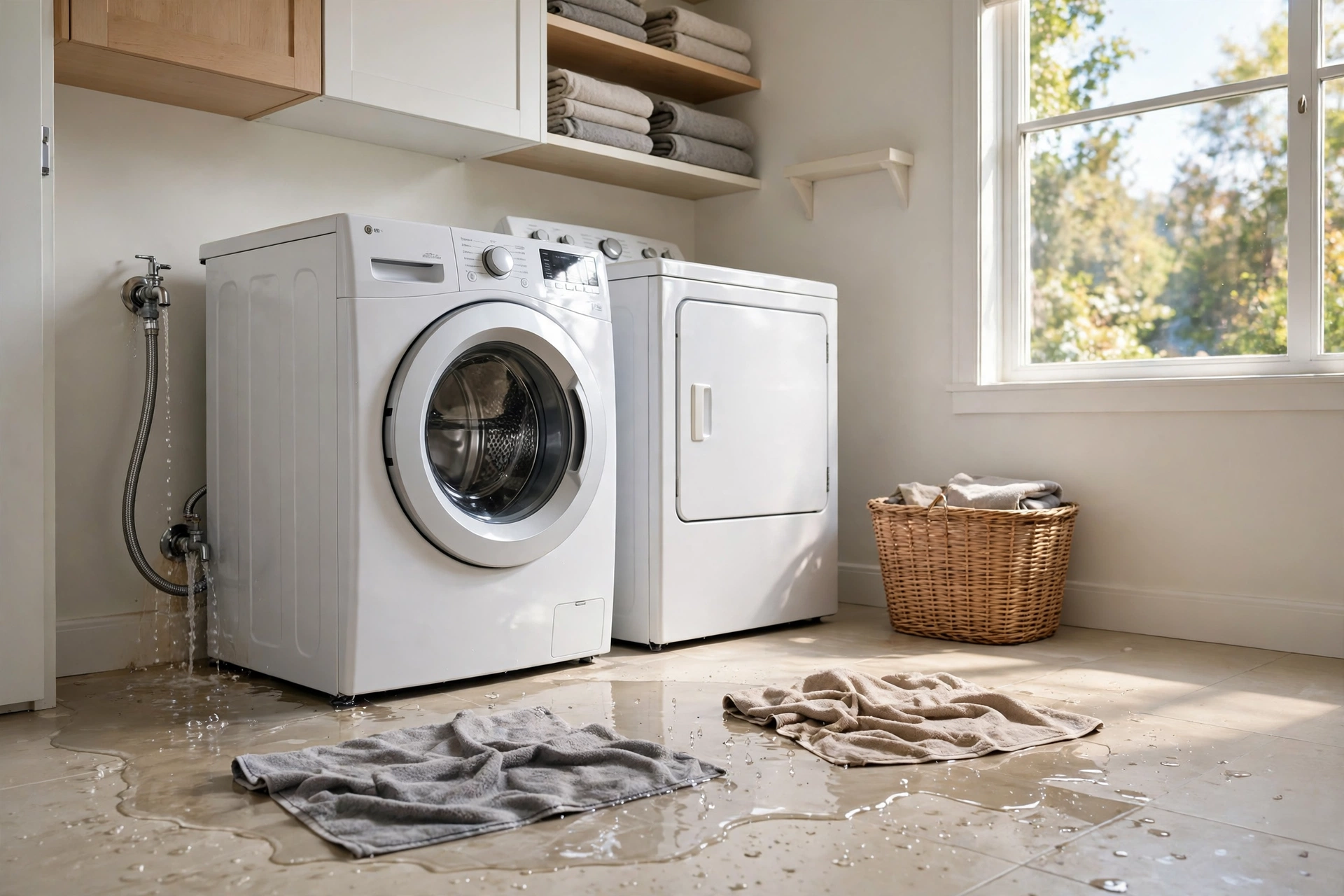
Emergency washer repair covers urgent faults: a washer flooding the laundry room, water leaking onto floors, or a washer stuck mid-cycle with a full drum. A local provider is matched to your city and the fault is stopped first, then repaired.
Most washer faults are inconvenient. A few are urgent. Water on the floor is urgent — it damages flooring, baseboards, and anything stored nearby, and on an upper floor it spreads to the rooms below. A washer stuck full of water is urgent too, because the clothes inside cannot wait and the door on a front-load machine will not open while the drum is full.
An emergency visit has a different order of work from a routine one. First the water is stopped: the supply valves behind the machine are closed, the machine is switched off, and the leak is found. Then the fault is diagnosed and repaired. Stopping the water matters more than naming the part, because every minute of leaking adds damage.
A washer flooding the laundry room
A flooding washer usually has a failed inlet valve, a split supply hose, or a drain fault that lets the drum overfill. The inlet valve controls water coming into the machine; when it sticks open, water keeps flowing even when the machine is off. A split supply hose releases water at full pressure. A blocked drain with a running fill cycle overflows the tub.
The first step is always the same: close the two supply valves behind the machine — one hot, one cold — and switch the machine off at the wall. Then move anything on the floor out of the water and mop up what you can. Towels on the floor slow the spread, but they do not stop it; the valves do.
Once the water is stopped, the provider finds the source. A valve that sticks open is replaced. A split hose is replaced, usually with a braided steel hose. A drain fault is cleared and the pump tested. The machine is then run through a full cycle to make sure the fault is gone before the visit ends.
A leak spreading through the house
A leaking washer on an upper floor is a water problem for the whole house, not just the laundry room. Water follows gravity and finds its way through floors, ceilings, and walls, and the damage is often worse below than it is beside the machine. A stain on the ceiling under a laundry room is a sign that a leak has been running for a while.
If you see water coming through a ceiling, close the supply valves to the washer first, then check the rooms below. Move furniture and anything that can be damaged, and mop up standing water. Do not switch the washer back on until the leak has been found and fixed.
Providers treat upper-floor leaks as urgent because the damage grows with time. The visit focuses on the leak source — hose, valve, pump, tub seal, or door seal — and the machine is tested with a full cycle before the provider leaves.
Washer stuck mid-cycle with a full drum
A washer stuck mid-cycle with a full drum is urgent because the clothes inside are soaking and the machine cannot be emptied normally. On a front-load machine the door stays locked while the drum is full, so forcing it open floods the floor. On a top-load machine the lid can usually be opened, but the drum is still full of water.
The cause is usually the drain: a blocked pump filter, a kinked drain hose, or a failed drain pump. Sometimes the cause is the lid switch or door latch, which stops the cycle from advancing. The provider drains the machine — usually through the pump filter drain or by lowering the drain hose — then finds and fixes the fault.
Do not tip the machine or force the door. A full drum is heavy, and water on the floor makes the area slippery. If the machine is leaking as well as stuck, close the supply valves first.
What to do first — before the visit
There are four things you can do safely before a provider arrives. First, close the hot and cold supply valves behind the machine. Second, switch the machine off at the wall. Third, mop up standing water and move anything on the floor that can be damaged. Fourth, note what the machine was doing when the fault started — filling, washing, draining, or spinning — and whether the leak is at the front, the back, or underneath.
Do not open the machine up yourself, and do not run it again to see if the fault repeats. A machine that has flooded once will flood again if the fault is still there, and running it adds water to the damage.
When you contact us, describe the fault in your own words: where the water is, what the machine was doing, and whether it is still leaking. That description is what matches you with a provider in your city.
What counts as urgent — and what can wait
Water on the floor is urgent. A washer that has stopped working but is not leaking can usually wait for a routine visit. A washer that makes a loud noise but still finishes its cycle can usually wait too, though it should not be ignored — a grinding noise is a bearing wearing out, and it gets worse.
A washer that will not drain but is not leaking is uncomfortable rather than urgent, unless the drum is full and the door will not open. A washer that leaks a small amount only during the spin cycle needs a visit soon, but it is not an emergency if you can catch the water and keep the machine off.
When in doubt, describe the fault and let the provider decide. A short description — where the water is, what the machine was doing — is enough to tell whether the visit is urgent.
What affects the cost of an emergency repair
An emergency repair costs what the repair costs. The part is the main factor — a supply hose and an inlet valve are different jobs from a drain pump or a tub seal. The time of the visit can matter too, because an urgent visit is fitted around other work.
The provider explains the cost before the work starts, including the part and what the repair involves. Stopping the water is always the first step, and that part of the visit is straightforward: close the valves, find the leak, fix the source.