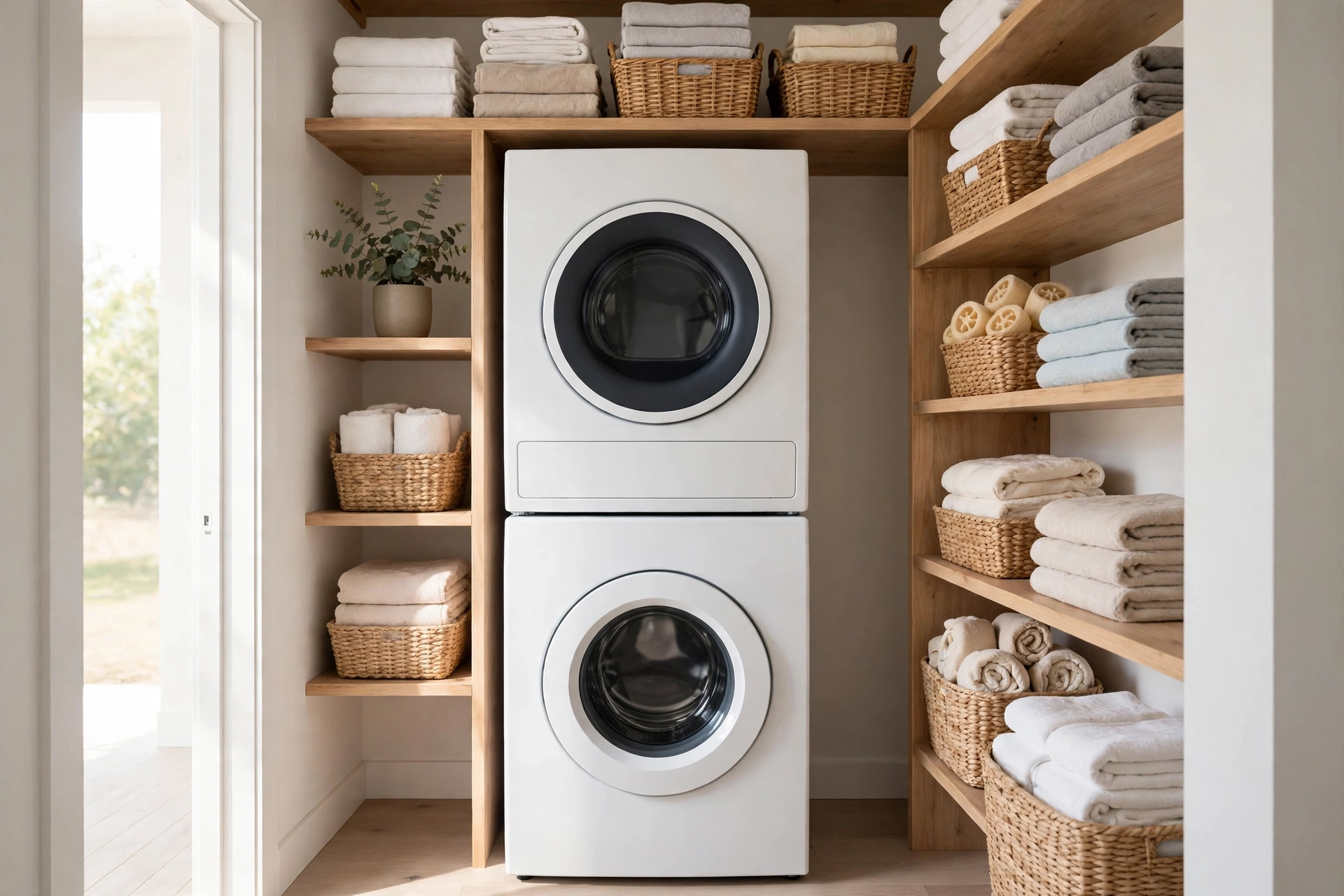
Kenmore washer and dryer repair covers washers stopped mid-cycle with water in the drum, gas dryer faults, control panels that will not power on, and cycle knobs that stick. A local provider diagnoses the machine at your home and repairs the faulty part.
Kenmore machines are older than most brands on this site, and that is part of their story. They were sold for decades, they were built to last, and many of them are still running — with the occasional repair. Their faults are the faults of machines that have worked for a long time: lid switches, drive belts, motor couplings, and control panels.
Kenmore washers are usually top-load machines with an agitator, and Kenmore dryers are usually electric or gas machines with a simple design. Parts for Kenmore machines can take longer to find than parts for current brands, because the brand is no longer sold new — and the provider will say so plainly if a part needs ordering.
Common Kenmore faults at a glance
- Washer stopped mid-cycle
- Gas dryer faults
- Control panel fault
- Cycle knob fault
- Washer will not spin
- Dryer not heating
Kenmore washer stopped mid-cycle
A Kenmore washer that has stopped mid-cycle with water in the drum usually has a drain fault or a lid switch fault. The drain fault is usually a blocked pump filter, a kinked drain hose, or a failed drain pump. The lid switch fault stops the cycle from advancing, even though the machine has filled and washed.
The machine needs to be drained before the door or lid is opened, and before the fault is found. On a top-load machine the lid can usually be opened, but the drum is still full of water. On a front-load machine the door stays locked while the drum is full.
Do not tip the machine to empty it. A full drum is heavy, and water on the floor makes the area slippery. If the machine is leaking as well as stuck, close the supply valves first.
Kenmore gas dryer faults
Kenmore gas dryers most often fail on heat. The igniter lights the gas, and when it fails the dryer runs cold. The gas valve controls the gas flow, and when it fails the burner does not light. The flame sensor watches the flame, and when it fails the burner shuts off.
A gas dryer that heats for a few minutes and then goes cold usually has a failing gas valve coil — it works while cold and fails as it warms up. A gas dryer that never heats usually has a failed igniter.
Gas connections are checked for leaks as part of every gas dryer visit. If a gas smell is present, the gas supply should be closed and the room ventilated before the visit.
Control panel and cycle knob faults
A Kenmore control panel that will not power on usually has a power fault — the outlet, the breaker, or the control board. The provider checks the outlet and breaker first, then the board.
A cycle knob that is stuck, or that turns without changing the cycle, usually has a faulty selector or a worn knob. The selector is tested first, because it is a small part and a common failure on older machines.
Spare parts for Kenmore machines can take longer to find, because the brand is no longer sold new. The provider will say if a part needs ordering and give a realistic time.
Repair or replace a Kenmore machine
The repair-or-replace question comes down to the age of the machine, the cost of the part, and how much life the machine has left. A Kenmore machine with a failed lid switch, belt, or igniter is usually worth repairing — these are sturdy machines, and the repair is usually straightforward.
A machine with a failed control board or transmission is a different decision, especially if the part is hard to find. The provider will give an honest answer once the fault is known, including whether the part is available and how long it will take.
What to tell your provider about your Kenmore machine
Tell the provider the brand, the model number, and the fault in your own words. The model number is usually on a label inside the door or on the back of the machine, and it matters more than the brand name alone — two Kenmore machines from different years can use different pumps, different door locks, and different control boards. If the machine shows an error code, write it down exactly before switching the machine off and on again, because the code can clear when the machine restarts.
Say when the fault started and whether it has happened before. A fault that comes and goes points to a different cause than a fault that is there every cycle. Say whether the machine fills and drains normally, whether the drum turns, and whether the door or lid locks. If the machine is leaking, say where the water appears. Those details are usually enough for a provider to bring the right part for your Kenmore machine on the first visit.